Our experience with an Engine Run-Up Simulator
Take a look at our Video:
Our Interview with a Run-up Trainer
- What are the most important points you pay particular attention to during the run-up after an engine change?
After an engine change, it is crucial to closely monitor all engine parameters: oil pressure, RPM, exhaust gas temperature (EGT) and vibrations. We also check that all systems are correctly connected and vented. Safety on the ground and clear communication within the team always come first.
- How do the run-up procedures differ depending on the aircraft type or engine type?
Each aircraft type has specific checklists and limits. The procedure is relatively simple for a single-engine propeller aircraft, while complex limits, software versions and automatic checks play a role for a multi-engine jet. The behaviour of the engine during start-up also differs significantly depending on the manufacturer.
- What typical mistakes or misunderstandings do you often observe among mechanics during the run-up?
A common mistake is that some build up power too quickly without waiting for the parameters to stabilise. Others forget small but important points such as removing safety pins or correctly configuring the FADEC systems. In addition, there are sometimes communication gaps between the cockpit and ground personnel.
- How is the safety of the mechanics and the aircraft ensured during a run-up?
We work with clearly defined restricted areas, secure the aircraft with chocks and ensure that there are no loose objects in the vicinity (FOD protection). The safety observer remains in radio contact throughout the entire run-up. In addition, a briefing is held before each test so that everyone knows what to do.
- Which instruments or parameters are crucial during the run-up for assessing the condition of the engine?
The most important ones are EGT, N1/N2 speeds *), fuel flow, oil pressure and temperature. Vibration values are also monitored. In modern jets, digital diagnostic systems that automatically record deviations also play a role.
*) Rotational speeds inside a turbine engine, expressed as % of maximum RPM. N1 → the front section, N2 → the core (middle/back section)
- How do you assess whether a mechanic is ready to perform a run-up independently?
I make sure that the mechanic has a firm grasp of all procedures, uses checklists correctly and pays attention to parameters and safety. If they can perform the run-up calmly and without errors and without instruction, they are ready to work independently.
- What requirements or qualifications must a mechanic meet in order to be allowed to perform run-ups at all?
They need appropriate training and approval from the company, usually in accordance with EASA Part-145 (globeair.com). Experience in the field of engines or avionics is helpful. They must also be thoroughly familiar with run-up and emergency procedures, especially how to respond to a fire warning or sudden loss of power.
- How often do you conduct training or refresher courses for run-ups, and what do you focus on?
As a rule, there are annual refresher courses. We focus on new procedures, technical changes and safety reports. If a mechanic has not performed a run-up for a long time, they receive targeted retraining.
- How do you deal with unusual situations, e.g. if irregularities occur during the run-up?
The most important thing is to stay calm. We stop the test immediately, note down the values and carry out a root cause analysis. Often it is just a sensor error, but if there are genuine technical problems, the aircraft remains on the ground until everything has been clarified.
- What technical or organisational improvements would you like to see for the run-up procedure in the future?
I would like to see more standardised procedures between different aircraft types and better digital support, e.g. through automatically generated test reports. Hybrid training with simulations could also help to further reduce the risk in real operation.
Experiencing the Engine Run-up – Project Reflection
At the start of the project with The Horse (the-horse.education), we had a clear but still fairly simple idea of our goals. The intention was to produce a video, that demonstrates how an Airplane takes off and how to fly it in a circle. The idea was exciting and immediately motivated us.
At the same time, we were aware that we were venturing into unfamiliar territory. None of us had any extensive experience with flight simulators or the precise technical processes in an Airplane cockpit. The start of the project was characterized by this combination of curiosity, uncertainty, and interest.
After initial clarifications, however, we realized that the simulator was not intended for actual flying but was used specifically for engine run-ups. This insight led to a change in our original concept but also opened new possibilities. An essential part of flight preparation is the engine run-up, which is important for safety.
This gave the project greater significance, and we quickly realized that we would not only be recording a video but also learning a lot. It was necessary to organize everything before we could really get started.
Our vocational trainer spoke with us and immediately offered his support. His enthusiasm gave us confidence and the feeling that we were on the right track. We then obtained the consent of our vocational trainer to carry out the project during working hours. Our anticipation grew when we got the go-ahead, but so did our respect for the task.
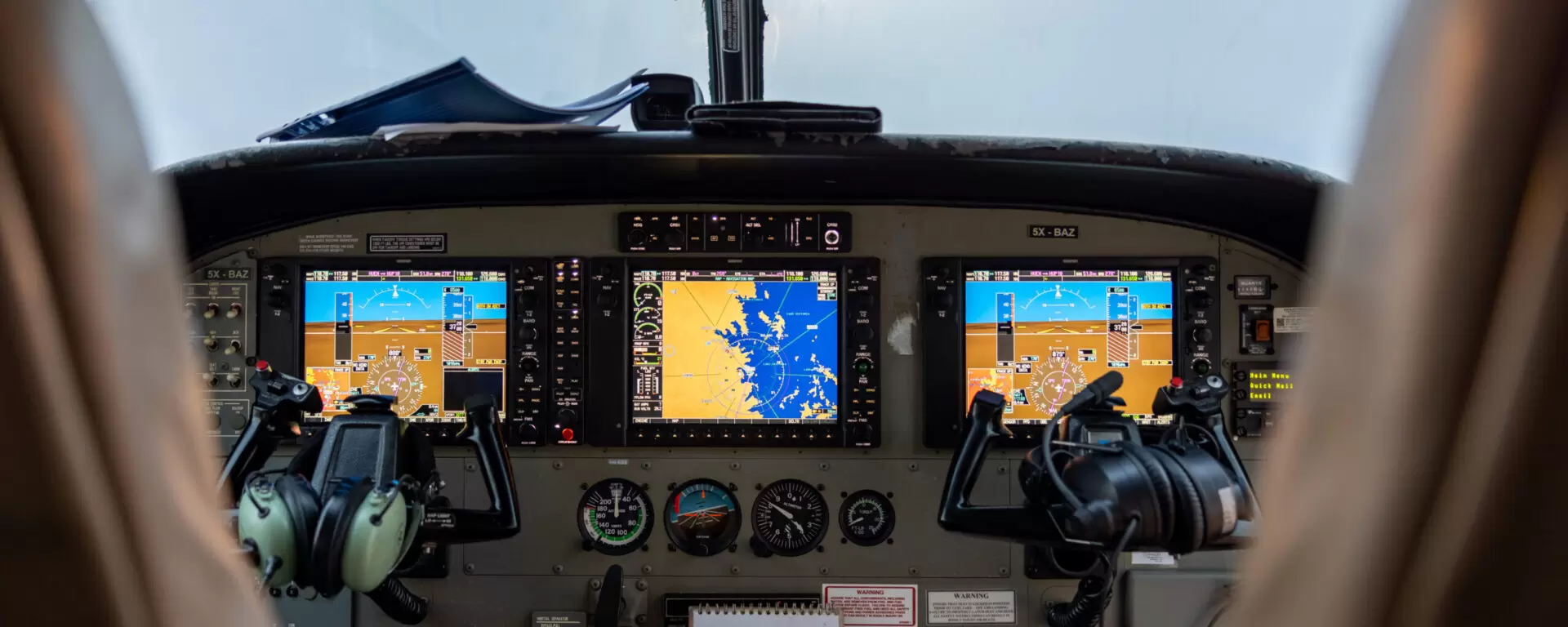
Our first experience with the simulator was impressive. The cockpit seemed complex and almost cluttered. There were switches, displays, and levers everywhere that at first glance seemed unrelated. At first, we were a little overwhelmed because we didn’t know where to start.
However, this is exactly where the learning process began. We worked our way through the checklist step by step. This list gave us structure and helped us not to overlook anything. It was our anchor, like a common thread.
During the engine run-ups, we realized how much responsibility each individual step entails. When the engine speed increases, not only does the noise change, but so does the atmosphere in the cabin. The engine runs smoothly, which radiates calm and confidence.
At the same time, it is immediately apparent if something is wrong. We were particularly impressed by the interaction between technology, hearing, and feeling.
It demonstrated that pilots rely not only on instruments but also on their perceptions. Checking the individual systems was another important aspect. Full concentration was required when testing the ignition circuits, activating the carburetor preheating, and observing the instruments. Every drop in speed was significant and required correct classification.
At first, we were afraid of making a mistake or skipping a step. But with each repetition, we became more confident. Uncertainty developed into routine, and routine led to confidence in our own actions. Teamwork was also very important, in addition to the technology.
It was necessary for us to coordinate with each other, distribute tasks, and trust each other. Mistakes were addressed openly without blame.
This open communication contributed to our growth as a team. We became particularly aware of how essential cooperation is when we were under time pressure because our attempts in the simulator room were limited. When we realized that the room would be needed by other students later, the pressure increased noticeably. Nevertheless, we managed to stay calm and work with focus.
In addition, international cooperation presented a challenge. The students in India and Indonesia used a different simulator and had different expectations. These differences added to the complexity of the project but also made it more interesting.
We had to learn to communicate our results clearly and be flexible. Although it was not always easy, we rose to this challenge and tried to make the best of it. The project also showed us that learning does not always go smoothly. Doubts, difficulties, and surprises are part of the process. The key is how you deal with them.
We are proud that we rose to these challenges and learned a lot from them. In the end, we not only have a finished video, but also the realization that we have surpassed ourselves and gained valuable experience that will stay with us in the future.
We collaborated with a team from Indonesia who studied the use of flight simulation to develop real aviation discipline. Read their contribution Learn how to fly a plane in simulation here!
Authors
Niklas Müller
Marc Boltshauser
(reviewed by Jael Locher)
Sources
“Airplane Cockpit” by World Travel Adventures (stocksnap.io) is marked with CC0 1.0.
The 3rd International Horse Conference, 2025:
Pitching ‘Aircraft Engine Run-up Simulator’ (vimeo.com)
On-topic posts on dontwastemy.energy
☷ See the project teams here »
☵ Some words about the contributions »
☴ Our sponsors and partners » (the-horse.education)
Demonstrating the importance of, and how to perform, a run-up check (on an aeroplane simulator) offers an surprisingly interesting insight into a topic I was previously unaware.
This contribution is a powerful combination of expert knowledge, authentic learning and your project experience!