

Introduction and Motivation
Heritage Hustle is a digital learning game built on a simple but demanding idea: cultural education should be engaging, respectful, and light on resources. The project explores how mobile games can help young people reconnect with cultural heritage while avoiding the excesses that often define digital entertainment today.
This is a conceptual study of a cross-cultural educational app, which is the first step toward creating it.
Young people now grow up surrounded by screens, algorithms, and endless streams of content. While access to information has expanded dramatically, the range of cultural stories being shared has narrowed. Global platforms tend to promote the same styles, references, and narratives, often rooted in Western pop culture. As a result, many local traditions, languages, and histories are slowly pushed to the margins of everyday awareness.
This cultural narrowing happens alongside another, less visible problem. Digital experiences feel weightless, but they depend on energy-hungry systems: servers, data centers, powerful devices, and constant recharging. Games in particular have become larger, heavier, and more demanding, both in terms of data and electricity. In regions where electricity is still largely fossil-based, everyday digital play quietly adds to environmental pressure.
Heritage Hustle emerged at the intersection of these two challenges.
The project asks whether a digital game can slow things down instead of speeding them up, and whether play can be designed to value care, memory, and restraint.
Project Background and Collaboration
The project was developed under The Horse project (the-horse.education) by John Koshy in India, together with Falaah and Zikri in Indonesia. Rather than operating as a formal institution or large research group, the work grew through continuous exchange between the three contributors. Cultural research, design decisions, and technical choices were discussed openly, shaped by local knowledge and practical constraints.
This human-scale collaboration influenced the structure of the project. Cultural content was never abstracted or generalized without discussion. Indonesian traditions were documented locally, with attention to meaning, context, and everyday practice. Indian contributions focused on patterns, architecture, and system design. The goal was not to represent culture as spectacle, but as lived experience translated into play.
Game Concept and Structure
Heritage Hustle takes the form of a mobile educational game built around short, focused interactions. Instead of long sessions or complex mechanics, the game relies on 100 brief levels that can be completed in under two minutes. These micro-sessions fit naturally into daily life while reducing strain on devices and batteries.
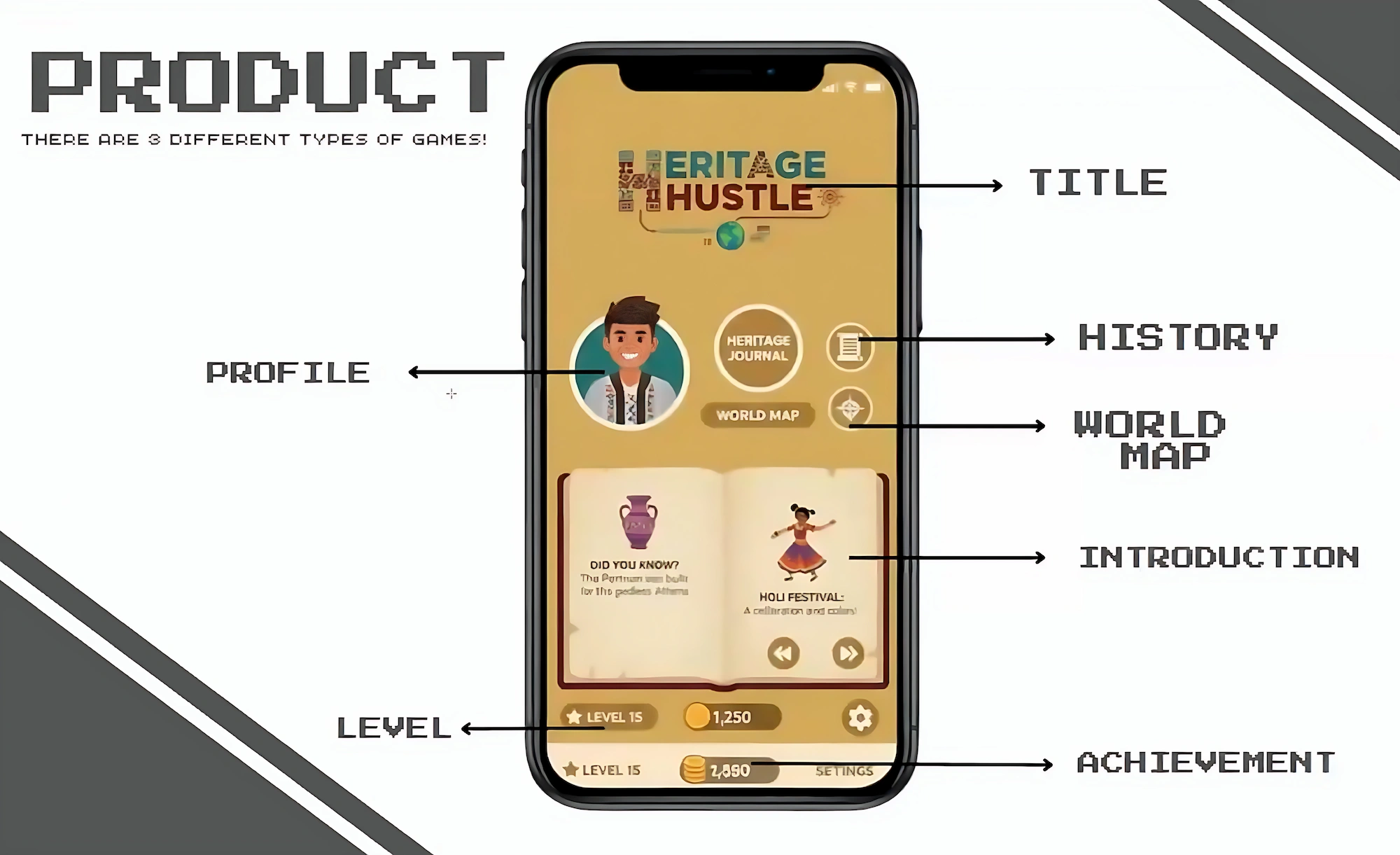
The game world is organized around five broad cultural themes: Ancient civilizations, international festivals, classical art styles, historical kingdoms, and languages and traditions.
Each theme is explored through simple interactions that mirror real cultural practices:
- Symmetry puzzles echo garden design and architecture
- rhythm-based challenges draw from festivals
- tracing mechanics follow traditional art techniques
- and navigation tasks reflect historical trade routes
Cultural Translation Through Play
A central concern during the development of Heritage Hustle was: how to translate cultural material into play without reducing it to trivia or spectacle. Many educational games fall into the trap of treating culture as a set of facts to be consumed quickly and forgotten just as fast.
Heritage Hustle deliberately takes a slower approach. Each interaction is designed to mirror a real-world cultural logic, whether that is the repetition and patience required in traditional art, the rhythm and timing found in festivals, or the spatial awareness needed to navigate historical trade routes.
By aligning mechanics with meaning, the game allows players to learn through doing rather than memorizing. Cultural elements are never presented as isolated information blocks; instead, they emerge naturally from the player’s actions. This approach also helps avoid cultural flattening. Rather than presenting a single global narrative, the game allows multiple traditions to exist side by side, each with its own visual language, pace, and logic.
The design process involved careful discussion about what to include and, just as importantly, what to leave out. Simplification was treated as an ethical decision rather than a purely technical one. The aim was not to cover everything, but to represent selected traditions with care, accuracy, and context. This philosophy shaped the Heritage Journal as well.
The journal does not function as a reward screen but as a quiet space for reflection, where fragments of knowledge accumulate over time. Rather than being pushed to rush forward, players earn progress through attention and curiosity.
In this way, Heritage Hustle positions play as a form of cultural encounter, one that values presence over speed and understanding over completion.
Learning and Progression
Progress in the game is recorded through a digital Heritage Journal. Rather than functioning as a score sheet, the journal grows into a personal collection of facts, illustrations, and short explanations. Each completed activity adds a permanent page, turning gameplay into a slow accumulation of knowledge. Learning is not treated as a reward layered on top of play, but as the core outcome of the experience.
Accessibility shapes every interaction. Gameplay relies on drag-and-drop actions, quick recognition tasks, tapping, and light exploration. These mechanics lower barriers for players of different ages and backgrounds, keeping the focus on observation and understanding rather than skill mastery. Avatar customization allows players to experiment with cultural clothing from different regions, encouraging familiarity and curiosity without framing culture as exotic or distant.
Technical and Environmental Design
From a technical perspective, Heritage Hustle is designed around the principle of digital sufficiency. Instead of maximizing visual intensity, the game minimizes digital weight. Vector-based animations replace heavy video files, keeping data usage low. User interfaces are designed around dark backgrounds, especially for OLED screens where black pixels consume little to no power. The game avoids energy-intensive 3D engines, relying instead on lightweight 2D environments.
These choices are not aesthetic trends but practical responses to global inequality in infrastructure. In regions where electricity grids rely heavily on coal, reducing battery drain and charging frequency directly lowers carbon impact. Keeping the app compact also makes it accessible to users with limited storage or slower connections. Sustainability is treated as a design constraint that quietly shapes every decision.
Educational Intent
Educationally, Heritage Hustle moves away from extractive reward systems common in mobile games. There are no randomized loot mechanics or artificial scarcity loops. Instead, progress is tied to understanding and completion. The Heritage Journal becomes a personal archive that players can revisit, reinforcing memory and ownership over what has been learned.
The project does not aim to replace formal education or offer exhaustive historical coverage. Its purpose is to spark interest, recognition, and respect. By presenting culture through interaction rather than instruction, the game encourages players to see heritage as something alive and relevant.
Reflection
The intercultural process behind Heritage Hustle was as important as the final product. Working across India and Indonesia with a small group required patience, trust, and constant communication. Without rigid roles, responsibilities shifted naturally based on context and expertise. Cultural accuracy was prioritized over speed, and technical efficiency was treated as a shared responsibility.
The Horse project (the-horse.education) provided a guiding framework focused on responsibility, environmental awareness, and education, but the project’s strength came from its scale. The collaboration showed that meaningful intercultural work does not require large teams or complex hierarchies. What it requires is attentiveness to context, openness to correction, and respect for difference.
Heritage Hustle demonstrates that digital education can be playful without being wasteful and serious without being heavy. It offers a model for how cultural heritage can be translated into interactive experiences that respect both people and the planet.
More broadly, it shows how small, cross-border collaborations can create work that is locally grounded, globally relevant, and carefully made.
Authors
John Koshy (India)
Muhammad Falaah (Indonesia)
Muhammad Said (Indonesia)
(reviewed by Jael Locher)
Sources
UNESCO. Education and Literacy Statistics, (unesco.org)
UNESCO, Intangible Cultural Heritage Framework. (unesco.org)
International Energy Agency (IEA). Electricity Grid Emissions Factors. (iea.org)
The Horse Project. BEFTER methodology and digital sufficiency principles.
Additional cultural material is based on primary research and local documentation conducted by the authors.
chat GPT for text correction & images
On-topic posts on dontwastemy.energy
☷ See the project teams here »
☵ Some words about the contributions »
☴ Our sponsors and partners » (the-horse.education)
This is a wonderful idea! Turning culture into something you experience through play is powerful. I can see a lot of potential in your concept, it seems to have been carefully thought out. I like your idea of micro-sessions for each level, the Heritage Journal and your “reduce to the max” approach, etc.
In Addition, your description of how the project went is exciting, too.
I’m curious, are you going to bring the app to reality? Have you considered crowdfunding on e.g. Kickstarter? Would love to see how this evolves!